
Your Treatment Journey
Before Treatment
Consultation
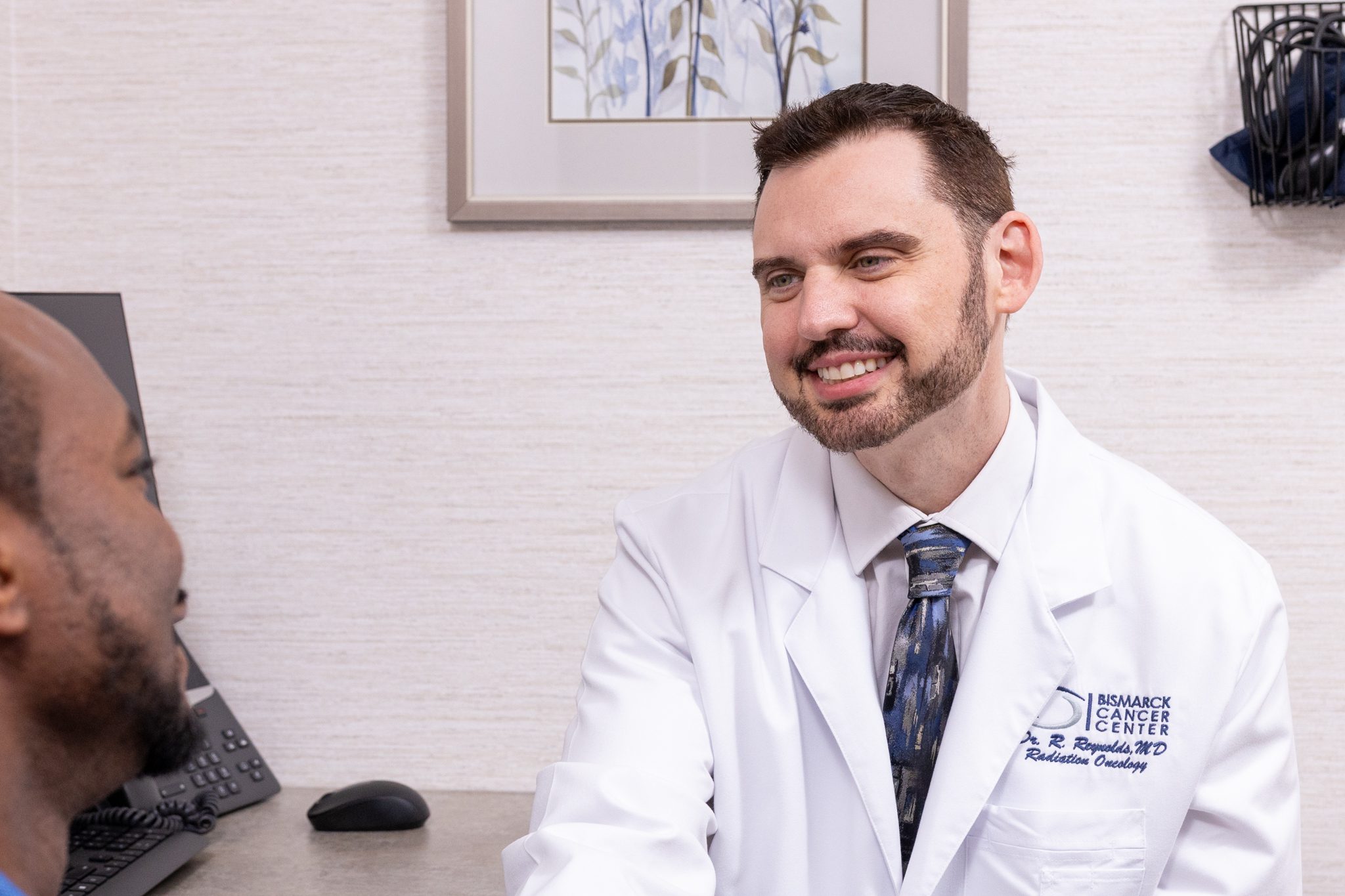
Before you begin treatment, you will meet with your radiation oncologist to review all of your medical information and conduct a physical exam. Following this exam, they will visit with you and any family members or friends you wish to include in the discussion. The doctor will discuss your diagnosis and possible treatment options that may be helpful to you. He or she will also discuss potential side effects and the number of treatments appropriate for you.
The CT Simulator “Planning Session”
One of the first steps you will need to have before receiving radiation therapy is called a “CT Simulation”. This is a dress rehearsal for your actual radiation therapy sessions. This CT scan is done in the exact position that you will be in for treatment. Every treatment plan is unique, and the simulation CT scan is used by your doctor to precisely plan where to direct the radiation beam.
To ensure the radiation dose is hitting the target every time, you must lay in the same position. To assist in reproducing the set up, you will have at least one positioning device used to help with comfort and consistency. The type used depends on your treatment plan and the part of your body being treated. This may include 3-4 small permanent marks (tattoos) to help with positioning during treatment.
Your planning session will last 30-45 minutes.
Treatment Planning
After the CT simulation, there will be a break before the first treatment.
During this time the dosimetry and physics planning team, work with your radiation oncologist to develop your treatment plan based off the CT data from simulation. There are also many quality assurance checks completed.
How often are my treatments?
The first treatment day will take longer due to additional imaging and verification scans for precise alignment. Treatments are usually given once a day and take approximately 15-30 minutes. All treatments are administered by radiation therapists. Please ask them any questions you have during treatment.
Treatments are given from 8 a.m. – 4 p.m. Monday through Friday.
Depending on the type and stage of the tumor, your doctor may prescribe one to eight weeks of radiation therapy. Patients who receive radiation treatments are not radioactive.
Your radiation oncologist will visit with you once a week to monitor your progress and address any symptoms you might be experiencing. You may also be asked to have blood drawn occasionally.
You should not miss any of your treatments unless approved by your doctor.
Video Walkthrough
During Treatment
During Each Treatment Visit
Getting Ready
Before your treatment begins, you may need to change into a gown or pants. Wear clothing that is easy to take off and put on again.
During Treatment
In the treatment room, you will lie on a treatment table while therapists use skin marks to align the radiation. Sessions last 15-30 minutes, and you must remain still.
You will not feel anything as the treatment is delivered but expect to hear machine noises. You’ll be alone in the room, but therapists will monitor you via a TV screen and intercom.
There are three treatment machines at BCC. All three look identical and have the same capabilities. Because of this, they are interchangeable, and you may be treated on any of the machines during the course of treatment.
After your treatment you can dress and resume normal activities. Most patients drive themselves to and from treatment.
Side effects vary based on the treatment area; your doctor and nurse will discuss them with you.
After Treatment
Recovering after treatment
Recovery Education
After radiation treatment, you will be educated on what to look for and how to take good care of yourself during recovery.
- Watch your skin in the treatment area as it may need some special care after radiation.
- Avoid sun exposure to the treatment area.
- Take naps as needed and try to get more sleep at night while healthy tissues are rebuilding.
- Understand it may take some individuals more time to regain strength than others.
- Prioritize activities until you are able to resume a full schedule.
- If you followed a special diet during treatment, learn what foods are appropriate following treatment.
Counseling and support groups
Cancer diagnosis and treatment can have a life-changing impact on the lives of patients and their loved ones. It can be an unfamiliar, stressful and often difficult time. The Bismarck Cancer Center and community organizations offer a variety of cancer support services.
Cancer Support Services
*Indicates programs facilitated by the Bismarck Cancer Center